

In the previous piece AI Doesn’t Have a Productivity Problem. It Has a Maturity Problem, I outlined the AI Integration Maturity Model and the stages businesses and organisations tend to move through as they integrate AI into live workflows. Many teams recognise themselves somewhere along that progression. Fewer are comfortable identifying where they may have stalled.
The data suggests most are still in experimentation.
Across surveyed knowledge workers, 69% are classified as AI experimenters and 28% as novices. Fewer than 3% operate at practitioner or expert level . At the same time, 85% report beginner or no value-driving AI use cases , and only 15% of reported use cases are considered likely to generate meaningful return .
Those numbers don’t describe resistance. They describe a ceiling.
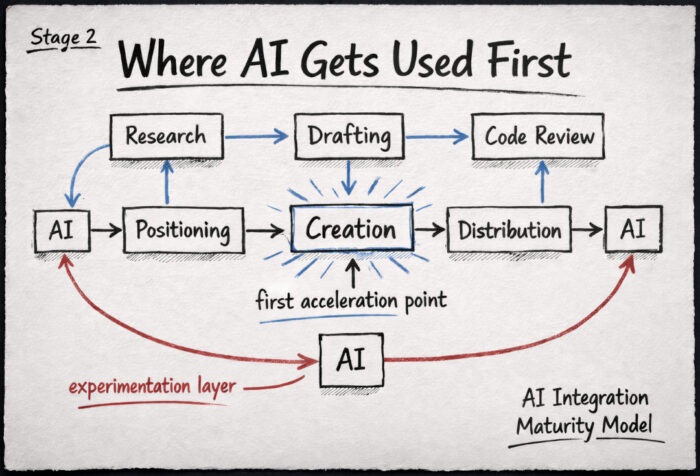
By this stage, access isn’t the constraint. The tools are available, policies have (or should have) been written, and regular usage has become normal. From the outside, it appears that integration is underway. Inside the workflow(s), the picture is more restrained.
Experimentation tends to attach itself to visible tasks first. Drafting improves. Research becomes lighter and engineers check their thinking against a model before committing to code. These shifts are tangible, and because they’re tangible they feel significant. The feedback loop is short. Effort drops quickly. And these reinforce the sense that something material is happening.
Often, the broader structure remains intact.
I was speaking recently with a marketing lead inside a mid-sized company. Her team had fully embraced AI. Campaign drafts that used to take half a day now took an hour. Variations could be generated quickly and internal review cycles shortened. On paper, this looked like measurable efficiency.
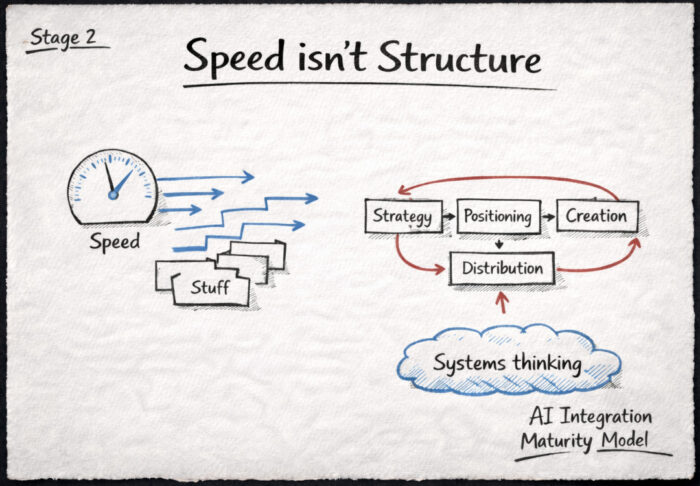
However, when we mapped the full workflow, nothing upstream or downstream had shifted. Positioning decisions were still debated late in the process. The distribution planning was reactive and reporting was assembled manually at the end of each campaign. The drafting was faster, but drafting wasn’t the constraint.
She wasn’t doing anything wrong. She was operating inside Stage 2.
Improving individual tasks doesn’t automatically improve the system those tasks belong to. If the sequence of decisions inside a workflow is unclear, speeding up one step rarely changes the outcome. If hand-offs between teams remain informal, acceleration at one point simply moves friction somewhere else. The work may feel lighter in places, but the architecture governing it hasn’t changed.
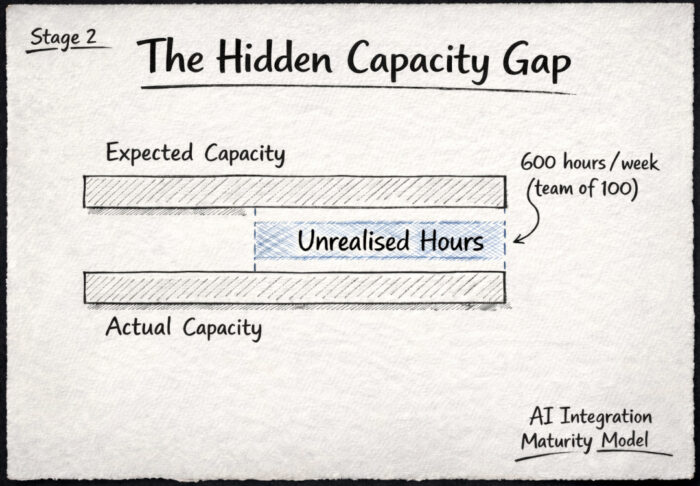
The research reflects that pattern. Nearly a quarter of respondents report saving no time at all . For many others, reported savings remain under four hours per week . Meanwhile, the level of reduction typically required to generate meaningful organisational return is materially higher .
The gap doesn’t look dramatic in isolation. But it does accumulate.
In a team of 100 knowledge workers, a six-hour shortfall per week equates to 600 hours of unrealised capacity. Over a quarter, that becomes thousands of hours that never convert into strategic movement. No single meeting highlights it but it builds quietly across roles and reporting lines.
This is the pattern that led me to build Structured Output Framework in the first place. Not to improve prompts in perfect isolation, but to impose structure around them. Without shared inputs and deliberate workflow redesign, experimentation stays local. With structure, those hours don’t disappear into noise. They convert into usable capacity.
If you’re reading this and recognising your own team, I’m unpacking each stage of the maturity model in sequence. You can join the list to receive the next piece directly rather than catching it later.
Stage 2 is necessary. It builds familiarity and lowers resistance. It allows individuals to discover where AI fits into their daily work. The mistake is assuming that widespread experimentation equals integration.
Integration begins when teams step back and examine how work flows end to end. It requires deciding which workflows should be redesigned rather than simply accelerated. It often exposes ambiguity in decision rights and hand-offs that experimentation quietly works around.
That exposure can feel uncomfortable, which is one reason organisations linger here longer than they intend.
Left unexamined, experimentation becomes the default operating mode. That is: usage remains high, activity remains visible but structural leverage remains largely unchanged.
In the next piece, I examine what shifts when organisations deliberately redesign workflows and begin moving into Stage 3 — AI Workflow Integration.
If you haven’t read the introduction to the maturity model, it provides useful context for this stage.
Continue the series
This article is part of a short series exploring how AI integration actually progresses inside real workflows.
If you'd like to receive the next article when it's published, leave your details below.
I'll send the next article when it's published.
I don't spam and you can unsubscribe at any time