
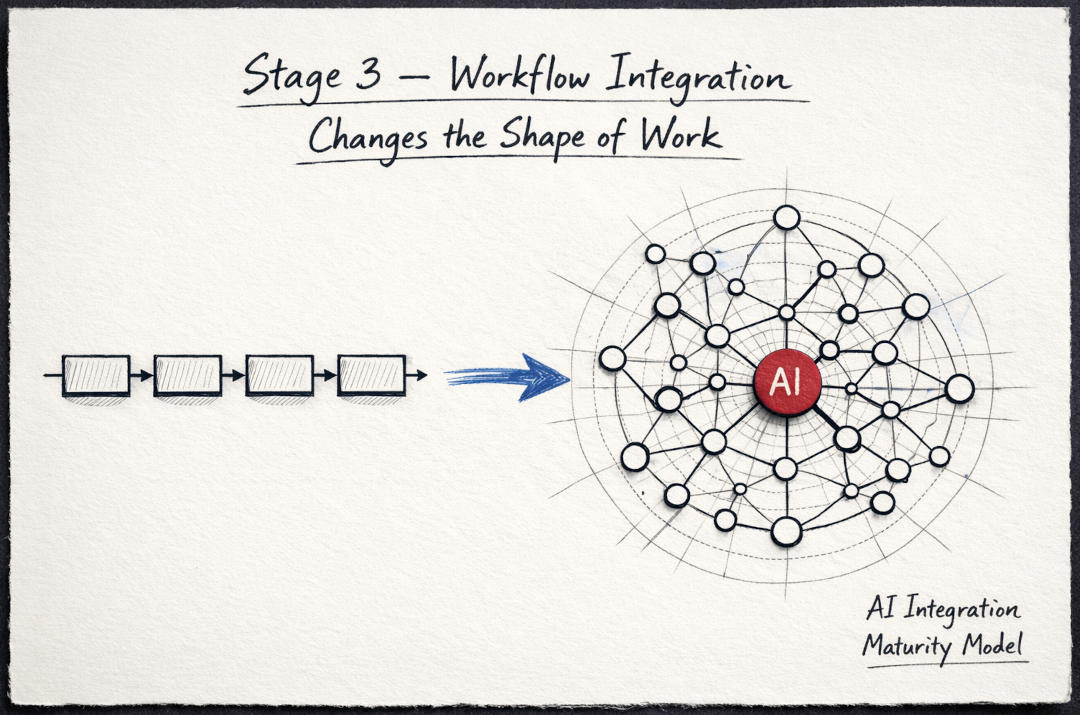
If Stage 2 is about acceleration, Stage 3 is about redesign.
The shift is subtle at first. Teams stop asking where AI can help and start asking which workflows should change because AI exists. Solo operators experience the same shift, just at a different scale. The question moves from “How can this speed up my task?” to “Why am I doing this sequence this way at all?”
What Is AI Workflow Integration?
AI workflow integration is the stage where artificial intelligence stops being used as an isolated tool and becomes embedded within the structure of a workflow.
Instead of accelerating individual tasks, AI becomes part of the system that moves work from trigger to outcome.
This changes the shape of work in three ways:
- tasks become connected
- inputs become structured
- outputs become predictable
When AI is integrated into a workflow, productivity gains stop appearing as scattered time savings and begin appearing as repeatable operational capacity.
This shift marks the transition from experimentation with AI to designing systems that use AI as a structural component of work.
Experimentation improves steps inside a process. Integration questions the process itself.
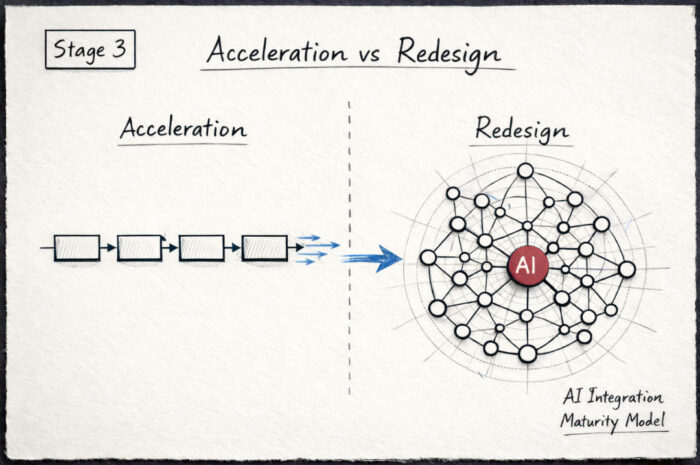
In Stage 2, AI supports tasks that already exist. A draft gets written faster, a report is summarised more cleanly and a code block is reviewed before merge. For a solo founder, proposals get produced quicker and research feels lighter. The surrounding structure remains largely intact.
In Stage 3, people begin mapping how work actually moves from trigger to outcome. For an SME or organisation, that might mean tracing a client request through qualification, delivery, reporting and review. For a solo operator, it might mean examining how ideas move from notes to published output to distribution and follow-up.
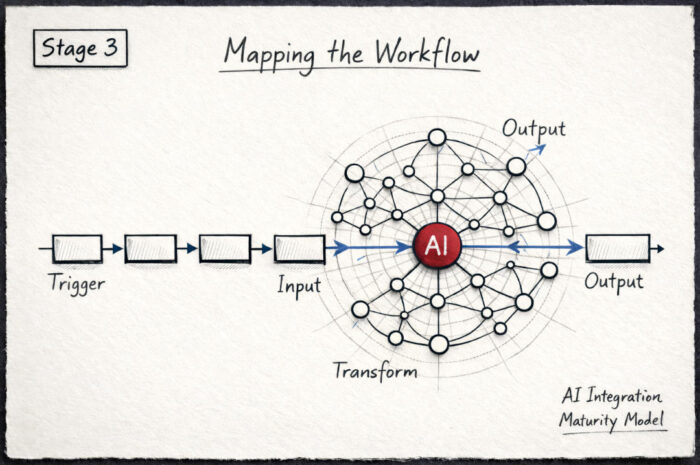
The redesign usually starts with inputs.
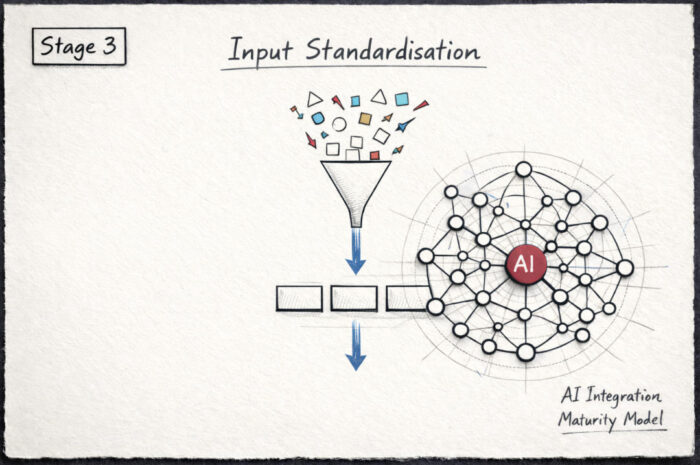
Reliable outputs depend on reliable inputs. If assumptions vary, if data is inconsistent, or if decision criteria shift between team members or even between days, results remain uneven. Experimentation tolerates that variability. Integration reduces it.
The research helps explain why this stage is rare. 69% of the workforce are still classified as AI experimenters and 28% as novices. That leaves fewer than 3% operating at practitioner or expert level. In addition, 85% of knowledge workers report beginner or no value-driving AI use cases, and 59% of reported use cases fall into basic task assistance.
Those figures describe how early most integration still is.
I’ve seen this shift most clearly in operations teams, but it applies equally to individuals.
One marketing team I worked with initially used AI to summarise weekly reports. It saved time and shortened meetings slightly. The friction returned because the data feeding those summaries was inconsistent across departments. When they standardised definitions and aligned on metrics first, then rebuilt the reporting workflow around AI, the improvement spread beyond one task.
A solo founder I spoke with had a similar experience. He used AI daily for content drafting and idea expansion. Output increased, but follow-through remained inconsistent. When he redesigned his weekly workflow around fixed inputs, structured prompts and defined review checkpoints, his output didn’t just increase. It stabilised. That stability made planning possible.
The time savings were no longer local to one activity. They became predictable.
This distinction matters because reported savings in Stage 2 remain modest for most users. Nearly a quarter report saving no time at all, and a significant portion report fewer than four hours per week. Meanwhile, meaningful return typically requires substantially more reduction per role.
Integration is what closes that gap.
Workflows are mapped explicitly rather than assumed. Inputs are standardised. Accountability shifts from individual experimentation to structural design. For a solo operator, that may simply mean deciding that certain tasks always begin with defined constraints rather than open-ended prompting.
This stage is less about sophistication and more about discipline.
It can feel uncomfortable because mapping workflows exposes ambiguity. Standardising inputs forces decisions that were previously avoided. Redesigning sequences often reveals how much invisible work was being carried by habit rather than structure.
It is also where measurable return begins.
When AI operates inside a repeatable workflow, time savings become predictable rather than incidental. Variability drops. Rework reduces significantly and capacity starts to appear in blocks rather than fragments.
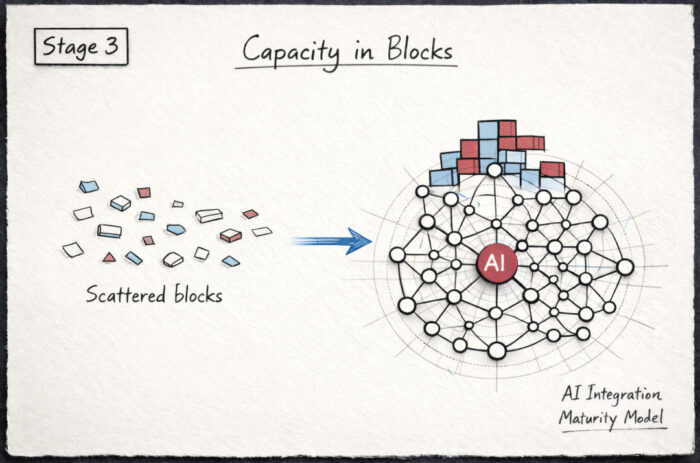
This is where Structured Output Framework becomes operational rather than conceptual.
Structured Output Framework wasn’t designed as a collection of clever prompts. It exists to impose structure on inputs and workflows so outputs become reliable across contexts. For teams, that means shared standards. For solo operators, it means consistent constraints and repeatable sequences. The principle is the same.
Key Takeaways
Stage 3 of the AI Integration Maturity Model marks the shift from experimenting with AI tools to redesigning workflows around AI.
At this stage:
- AI becomes embedded inside workflows
- inputs are standardised to stabilise outputs
- productivity gains become predictable capacity
Workflow integration is where organisations begin treating AI as infrastructure rather than software.
If you’re following this series because you suspect you’re somewhere between experimentation and integration, the next stage will likely feel less exciting and more deliberate. That’s usually a good sign.
I’ll unpack Stage 4 next, where AI moves beyond workflow redesign and becomes part of the operating model itself.
If you want the next piece directly, rather than finding it later, or to find out more about the Structured Output Framework, you can join the list below. Each stage builds on the last, and the progression makes more sense when read in sequence.
Continue the series
This article is part of a short series exploring how AI integration actually progresses inside real workflows.
If you'd like to receive the next article when it's published, leave your details below.
I'll send the next article when it's published.
I don't spam and you can unsubscribe at any time