
Turning AI Into Reliable Business Outcomes
I help founders and organisations improve ROI and customer satisfaction by bringing clarity to the workflows and decisions that drive performance.
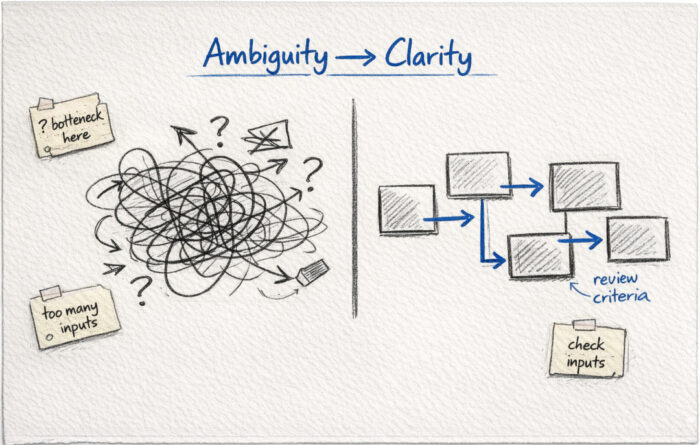
AI can be powerful. But when it is applied without structure it often creates more noise than clarity.
Most founders and organisations fall into two traps.
- They chase features instead of identifying the real constraint in the business
- They introduce tools before understanding how those tools fit into real workflows
The result is activity without reliability.
What businesses actually need is not more output.
They need clearer inputs, clearer decisions, and processes that produce predictable results.
That is where AI becomes useful.
If you’re exploring how AI could improve outcomes in your business
A short call to understand what you are trying to achieve and whether AI can genuinely help.
A Typical First Conversation
When founders or organisations reach out about AI, the first question is often something like:
“Where should we use AI?”
The conversation usually shifts quickly.
Instead of starting with tools, we look at a few practical questions.
- Where are decisions currently being made with incomplete or inconsistent inputs?
- Which processes create the most friction or delay?
- Where does output quality vary depending on who is doing the work?
- Which activities genuinely benefit from speed, and which require clarity instead?
Those questions usually reveal far more than any list of AI features.
Once the constraint is clear, it becomes easier to see whether AI improves the situation or simply adds another layer of activity.
Most of the time the real opportunity is not automation. It is removing ambiguity from the process itself.
That is where reliable improvement tends to begin.
Why Many AI Initiatives Stall
AI is often introduced too early or in the wrong place.
Without a clear baseline for how work flows through a business, AI ends up:
- speeding up tasks that do not need to be faster
- producing outputs nobody trusts
- increasing noise instead of insight
- creating more work to review and correct
Real performance improvement comes from reducing uncertainty inside the process itself.
AI can help with that, but only when it is applied deliberately.
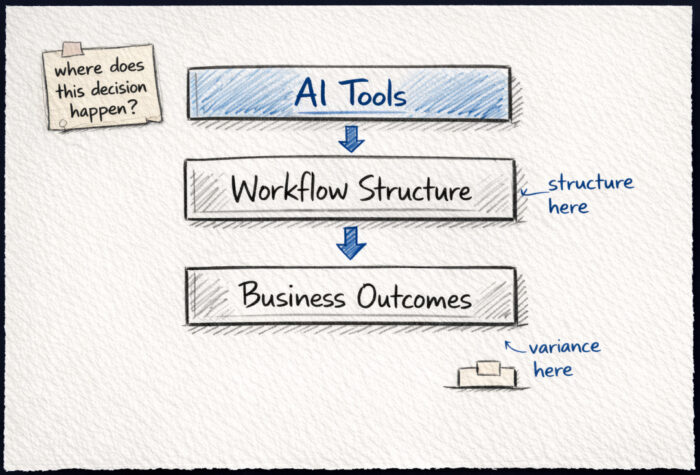
What Effective AI Integration Looks Like
When AI works well inside a business, it usually follows a simple progression.
- First clarify the decisions that actually drive outcomes
- Then ensure your inputs and signals are reliable
- Introduce automation and AI where they reduce friction
- Govern outputs so they can be trusted and reused
AI should support the structure of the business, not sit on top of it.
How I Help
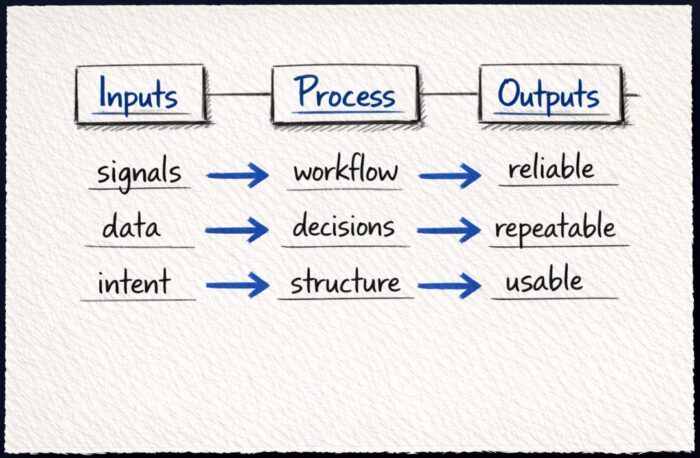
My role is not to sell tools.
I help founders and organisations think clearly about where AI genuinely improves outcomes and where it does not.
This typically involves:
- identifying the processes where ambiguity creates cost or friction
- simplifying workflows so decisions become easier to make
- introducing AI where it improves reliability and consistency
- ensuring outputs are usable rather than just impressive
The goal is not more automation.
The goal is clearer execution.
A Practical Way to Think About AI
Many founders and organisations start with a question like this:
“Where can we use AI?”
A better question is:
“Where are we currently making decisions with incomplete information or inconsistent inputs?”
That is usually where the real opportunity sits.
AI becomes valuable when it reduces uncertainty in those moments.
When This Work Becomes Useful
This work tends to help founders and organisations that want to move beyond experimentation.
They may already be using AI tools, but they are noticing that:
- results vary depending on who is using them
- results vary depending on who is using them
- workflows have become harder to manage
- outputs still require significant manual review
- the promised efficiency gains have not fully appeared
These are usually signals that structure needs attention before additional tools are introduced.
If You Want To Explore This
If you are trying to work out:
- whether AI actually makes sense for your business right now
- where integration would improve outcomes the most
- how to reduce guesswork inside key processes
we can talk.
Start a Conversation
A short discussion to understand what you are trying to achieve and whether AI can genuinely help.
Send a short message outlining what you’re exploring and I will personally reply directly.