
AI integration is not a switch that gets flipped. It unfolds.
Across organisations and solo operators the pattern is recognisable. Access arrives first and experimentation follows. Some then begin redesigning workflows deliberately but fewer embed AI into their operating model in a way that stabilises execution. Very few treat integration as something that must be reviewed and refined over time.
Maturity models are not new. They have been used for decades to describe how organisations develop capability in areas such as software engineering, cybersecurity, and governance.
The model introduced here applies the same thinking specifically to AI integration within everyday workflows.
The AI Integration Maturity Model describes that progression. It clarifies where structural change has occurred, where it has not, and why movement between stages is often slower than expected.
It applies across scale, from individuals working alone to complex organisations.
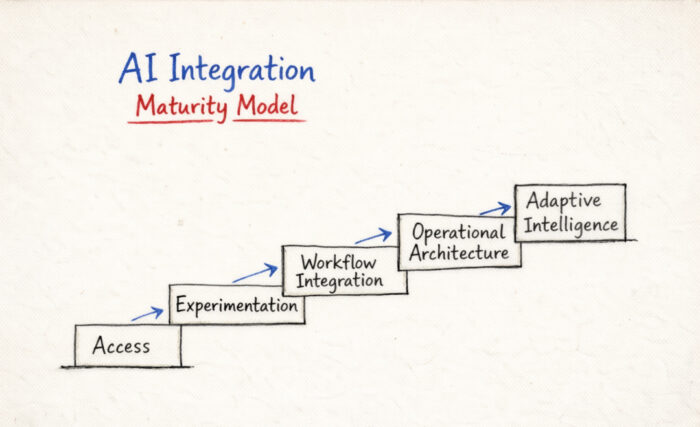
Stage 1 – Access
Access is the beginning, not the shift.
At this stage, tools are available and usage is permitted. Guardrails exist. Basic training may have been delivered. People begin testing where AI might assist.
The presence of tools can create the impression that integration has begun. In practice, very little about execution has changed. Workflows remain intact. Decision sequences are still interpreted individually. And variance continues because the structure carrying the work is unchanged.
Access reduces friction around experimentation but it does not yet reduce structural variability.
Movement beyond this stage becomes visible when AI usage shifts from occasional exploration to regular application inside defined tasks.
Stage 2 – Experimentation
Experimentation is where visible momentum tends to gather.
AI is applied to discrete tasks inside existing workflows. Drafts move more quickly. Research requires less manual effort and individuals check direction before committing. The lift in activity can feel meaningful, particularly when compared to previous friction.
What often goes unnoticed is that the workflow itself remains largely intact. Inputs still vary and decision criteria are still interpreted differently across roles. Faster drafting does not automatically improve outcomes if the sequence governing those drafts has not changed.
Because experimentation increases visible output, it is often mistaken as being integration. It has value, but it also has a ceiling. Progression begins when attention shifts from prompts to the structure within which those prompts operate.
Stage 3 – Workflow Integration
Workflow integration requires deliberate redesign.
At this stage, the sequence governing work becomes the focus. Inputs are clarified and hand-offs are reconsidered. AI is now embedded within structured workflows, rather than layered on top of them.
The change here is less visible than experimentation because activity may not spike in the same way. What changes instead is coherence. The steps align more deliberately. Output becomes less dependent on individual interpretation.
A common misconception is that integration is primarily about improving prompts. In practice, it is about reshaping the workflow so that prompts operate within defined constraints. Without shared standards, redesigned workflows still drift.
Movement beyond this stage becomes evident when outputs are reproducible across contexts, rather than dependent on individual prompting skill.
Stage 4 – Operational Architecture
When AI becomes part of the operating model itself, maturity deepens.
Standards are defined explicitly. Inputs are governed. Evaluation criteria are no longer implicit. At this point the system begins to carry consistency rather than relying on individuals to enforce it.
High usage alone does not indicate this stage. Architecture is visible in reduced variance and increased predictability. Output quality stabilises across roles and contexts.
The risk here is subtle. Stability can create the assumption that maturity has been reached permanently. Where in reality, structure without review eventually drifts as capability evolves.
Progression requires moving from stable execution to deliberate refinement.
Stage 5 – Adaptive Intelligence
Adaptive intelligence isn’t about constant change. It is about controlled evolution.
At this stage, workflows are revisited intentionally. Inputs are refined as model capability shifts. Assumptions are tested, rather than preserved. Review becomes part of the operating rhythm as opposed to a reaction to failure.
Maturity here isn’t louder. It is quieter. Execution feels stable because refinement is built in.
The absence of review gradually erodes alignment. Integration that is not examined hardens.
Adaptive intelligence recognises that capability evolves and structure must evolve with it.
The Model in Practice
Progression through these stages is not automatic. Experimentation lowers resistance but does not remove structural variability. Redesign introduces friction but increases leverage. Architecture stabilises execution but requires discipline. Adaptation prevents stagnation but demands review.
Research conducted by Section indicates that the majority of AI users remain at novice or experimenter levels, with only a small proportion operating at practitioner or expert tiers. Visible activity does not necessarily signal structural maturity.
Assessing maturity requires examining inputs, workflows, and evaluation criteria rather than usage volume alone.
Applying the Model
The AI Integration Maturity Model describes progression. Applying it requires structure.
The Structured Output Framework operationalises the model by governing inputs, workflows, and evaluation criteria so outputs become predictably reliable. It reduces variance so judgement can be applied deliberately rather than reactively.
The model defines maturity. Structure makes it measurable.
Continue the series
This article is part of a short series exploring how AI integration actually progresses inside real workflows.
If you'd like to receive the next article when it's published, leave your details below.
I'll send the next article when it's published.
I don't spam and you can unsubscribe at any time